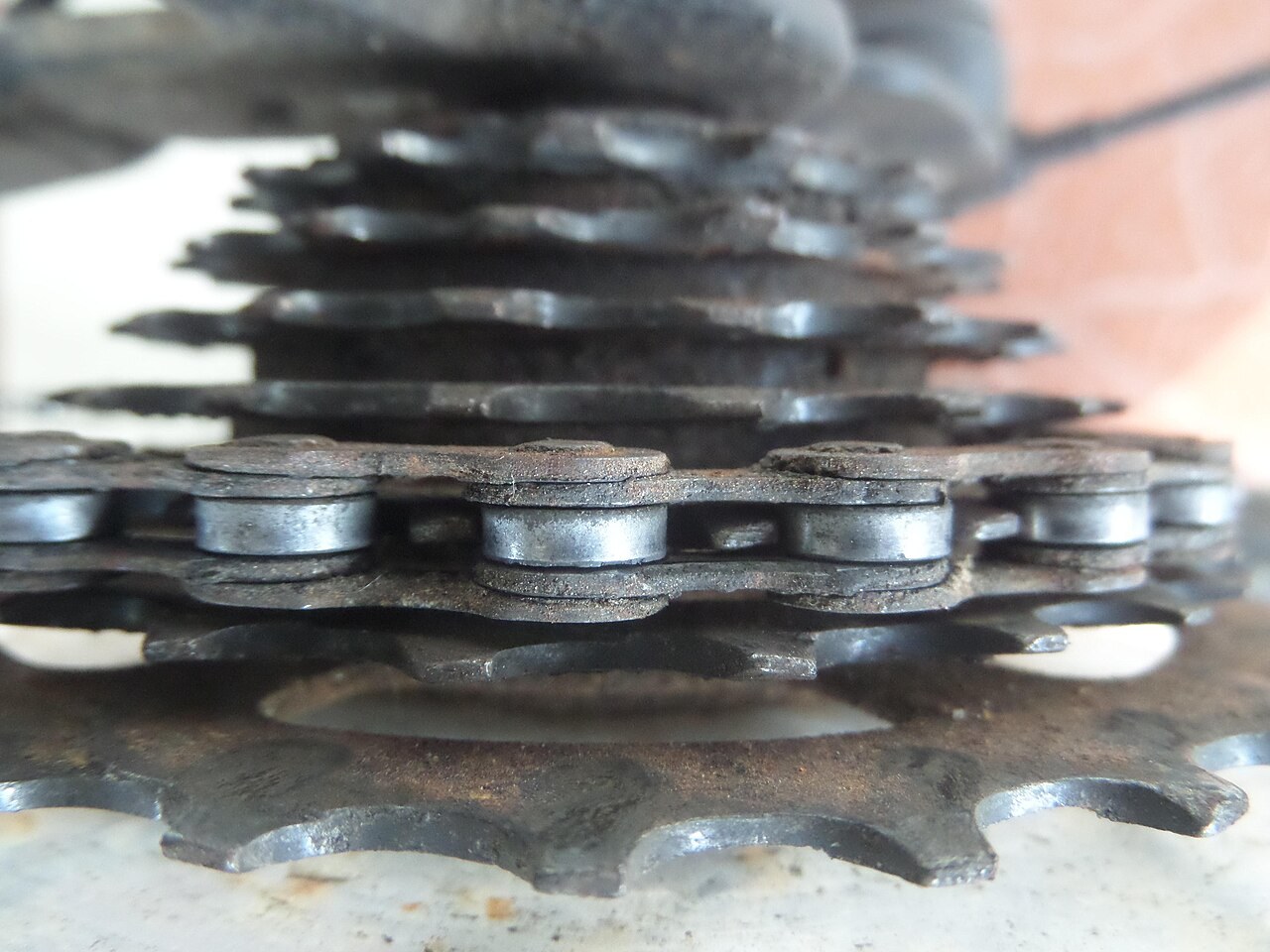
A shiny drivetrain looks cared for but says little about wear inside a bicycle chain. Separate cleaning, adjustment and wear. Ask which components were last replaced and whether the combination has been ridden together. A new chain fitted to older sprockets deserves specific questions rather than automatically being treated as a renewed drivetrain.
Use a suitable chain-wear measurement
Park Tool explains how wear in joint components alters effective chain length and can increase wear elsewhere in the drivetrain. A suitable chain gauge offers a better basis than shiny outer plates. It must suit the chain design and be used according to its instructions.
Limits differ by system and manufacturer. Do not transfer one percentage to every bicycle. For a workshop check, ask which tool was used and how the result was assessed. Measuring one dirty section or forcing a gauge can mislead.
Consider sprockets and shifting together
Look for visible tooth damage without treating shape alone as a definitive wear measurement. Some teeth deliberately differ to assist shifting. An inexperienced assumption that every tooth should look identical can therefore be wrong. Missing or obviously damaged areas remain specific findings.
A safe ordinary test ride may reveal skipping under normal load or poor shifting response. Braking and overall readiness must be established first. Avoid extreme-load experiments. Skipping has different possible causes; it does not prove that a new chain alone will resolve the problem.
Calculate replacement as a combination
Identify the required chain, cassette or chainrings for the actual system. Gear count alone does not establish full compatibility. Include matching components and competent adjustment in the comparison. Cheap chain cleaning is not an established remedy for worn contact surfaces.
Keep observations and maintenance claims together. Cleaning helps visual inspection but does not replace measurement. If the seller recently renewed wear items, ask exactly which ones. That makes it clear whether a claim of complete servicing concerns several components or only one replacement part.
Common questions
Can oil restore a worn chain?
No. Suitable lubrication supports operation but cannot reverse material wear that has already occurred.
Does every new chain require a new cassette?
Not universally. Condition, compatibility and behaviour of the particular system need assessment. Have the required replacement scope established professionally.