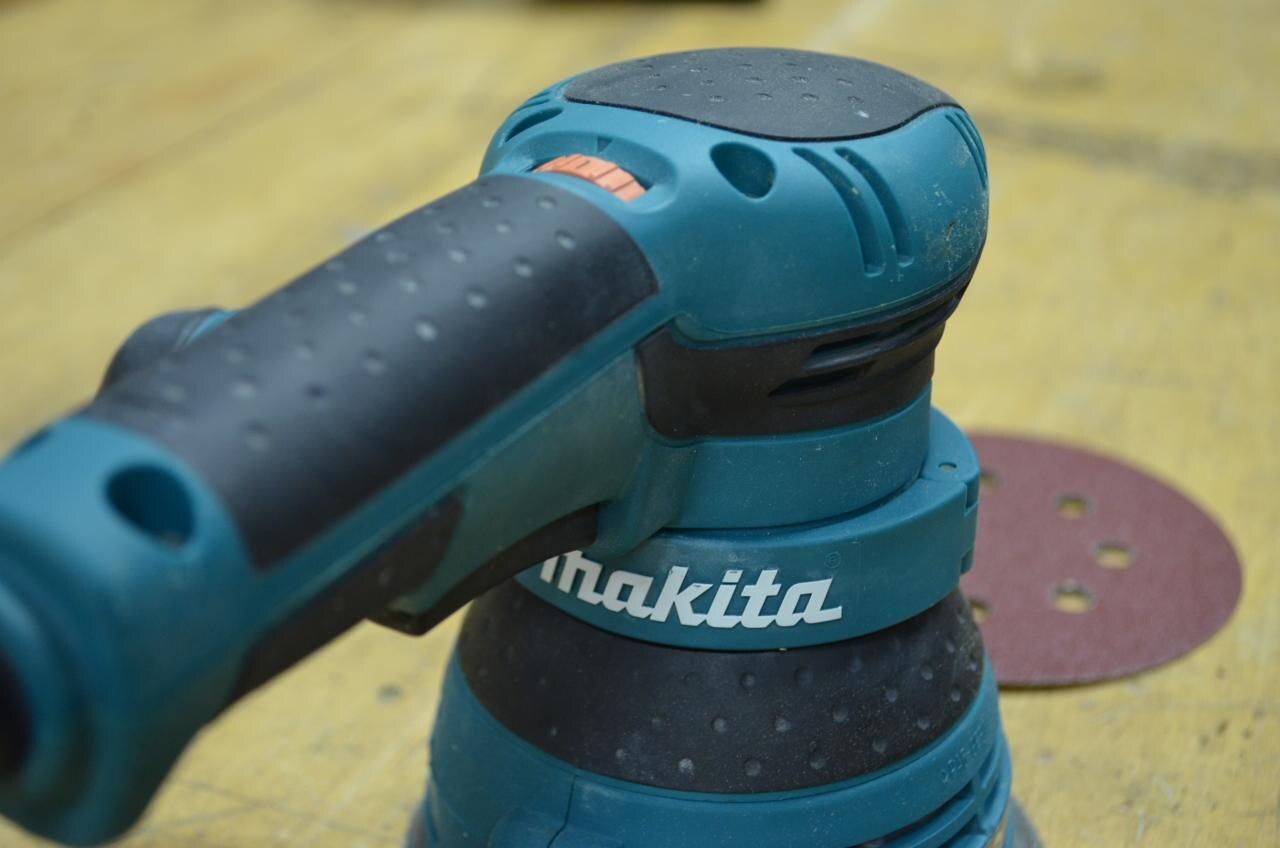
A used sander may look dusty while being maintained reasonably well. Conversely, a cleaned cabinet can conceal a worn mounting. Establish the model, intended abrasive and application. Random-orbit, sheet and other designs use different motions and accessories, so assess the actual construction rather than expecting every sanding tool to behave identically.
Inspect the mounting without power
Unplug the tool or remove its battery as directed. Examine the pad or plate, fixing and accessible edges. Record cracks, missing sections and heavily worn hook-and-loop surfaces. A used abrasive sheet is a different cost from a damaged pad.
Check fitted clamps or fastening components as intended. Do not substitute accessories merely because their dimensions look similar. Correct hole pattern and mounting matter. Bosch explains, for example, that holes in abrasives must align with intended extraction openings.
Include the complete dust path
Ask to see the collector, filter, adapter and any extraction connection. A missing seal or broken catch can restrict the usefulness of an otherwise running tool. Ask which material was last worked without treating residual dust as reliable identification of its composition.
Unknown old coatings or hazardous dust are not suitable demonstration materials. An ordinary trial needs suitable stock, the extraction specified by the instructions and appropriate protective equipment. A clean cabinet does not establish safe dust control. An arbitrary household vacuum is not automatically suitable either.
Observe movement without inventing a stress test
After an unremarkable exterior inspection, have intended operation shown according to the manual. Watch for pronounced unusual vibration, noise and odour. Do not confuse the design’s normal motion with a fault. Use documentation or competent assessment where uncertain.
A brief run measures neither remaining bearing life nor actual dust capture. Resolve unusual findings before buying and include matching pads, abrasives and extraction parts. Excessive pressure on a workpiece is not a sensible way to prove reserve power. Damaged wiring or electrical warning signs end the demonstration.
Common questions
Can I simply glue material onto a worn pad?
Not arbitrarily. Mounting, balance and adhesion must suit the design. Find the intended replacement or an explicitly suitable solution.
Does a dust bag provide complete protection?
That depends on the tool, material and required process. Follow the instructions and any additional protection needed for the particular task.